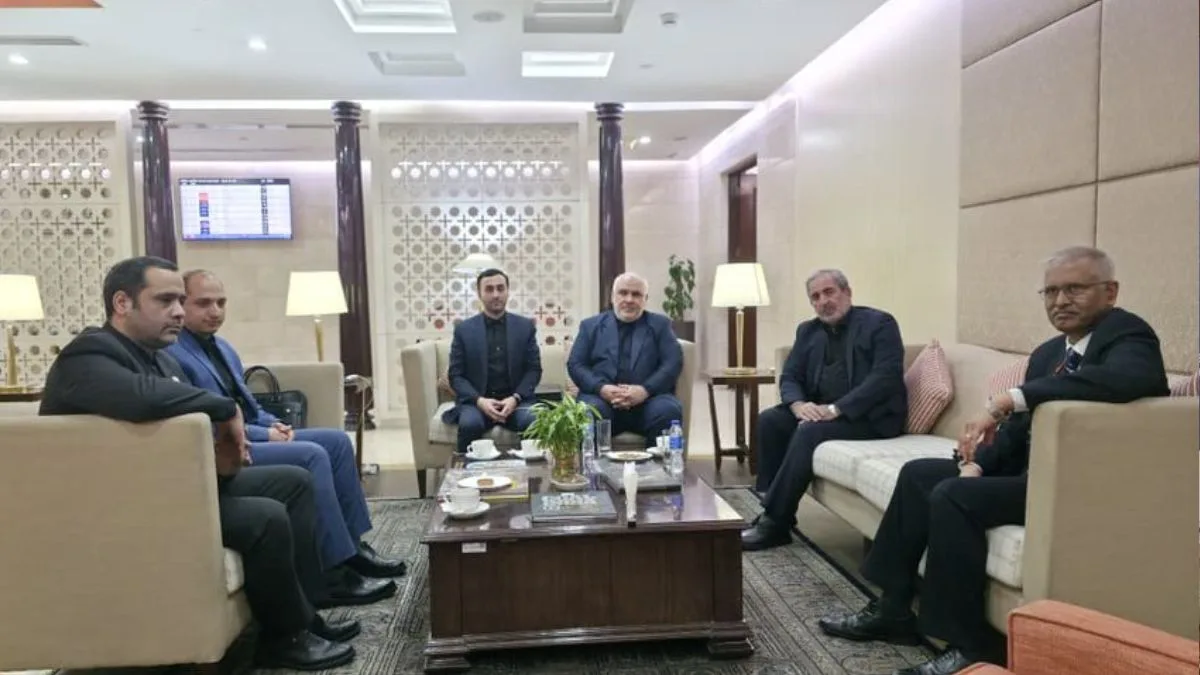
As peace talks between the US and Iran muddled through without any major breakthrough, Ghadir Nezami, Deputy Secretary of the Supreme National Security Council of Iran, landed at Delhi on Monday morning for a two-day meeting of the expanded BRICS grouping’s meeting of National Security Advisers.
Other leaders including Chinese Foreign Minister Wang Yi flew down as the day progressed for the meet to be chaired by India’s NSA Ajit Doval.
Advertisement
Officially, the agenda focuses on non-traditional security threats, which range from maritime security, cybersecurity, emerging technologies, terrorism, and information warfare.
Unofficially, however, the conflict in West Asia and its aftermath hangs over the high profile summit like an uninvited guest.
The gathering, chaired by India’s National Security Adviser Ajit Doval, is more than a routine security consultation. It represents the first major BRICS security-level engagement after a conflict that left after-shocks on all markets and economies worldwide, besides exposing significant divisions within the increasingly influential bloc.
The Iran war has underlined that the expanded BRICS, can at times of crises be as disunited as when it was a smaller grouping, given the fact that divergent strategic interests, political systems, and security alignments can always create fault-lines.
While Russia, China and Iran view the conflict largely through the prism of Western interventionism and regional power politics, countries such as India have sought a more nuanced position, emphasising diplomacy, de-escalation and steps to meet the economic consequences of prolonged instability.
These differences were visible during previous BRICS deliberations on the conflict, where members struggled to agree on a common statement on the Iran crisis.
“This time round the NSA meet comes at an unprecedented period when the conflict has wound down and peace talks are ongoing. The meet will certainly look into the threats to maritime security, several ships transiting through neutral waters were attacked,” Shantanu Mukharji, former National Security Advisor to Mauritius told UNI.
He pointed out that non-traditional threats such as drone warfare and cyber-attacks came to the fore during the recent conflict and the NSA meet “may look at a possible architecture to control the disruption of such unconventional warfare on the wider global community,”
Other officials said India will be focussing on three issues which are important to its security strategy. “Protection of supply chains in times of war, so that blockades or attacks on shipping do not disrupt global supplies, is obviously on everyone’s mind. However, we will have to listen to what measures other nations feel could be taken to ensure maritime security or security of sea-lanes,” said top officials.
India will also advance its long-standing campaign for deeper counter-terrorism cooperation. In a world increasingly characterised by proxy conflicts and asymmetric warfare, India believes that cooperation against terrorism can provide a relatively uncontroversial area of consensus even among countries that disagree on broader geopolitical questions.
“Another objective is to push BRICS toward developing common approaches to non-traditional security challenges,” officials said.
The Iran conflict demonstrated that modern wars extend far beyond battlefields. Cyberattacks, information manipulation, disruptions to maritime trade routes, satellite vulnerabilities, artificial intelligence-driven disinformation campaigns, and attacks on critical infrastructure have become integral components of contemporary conflict.
The summit also offers a valuable opportunity for bilateral engagement between Ajit Doval and Chinese Foreign Minister Wang Yi, who also serves as Beijing’s senior foreign policy and security official. Despite improvements in India-China relations since the tensions of the early 2020s, unresolved border disputes and broader strategic competition continue to define the relationship.
Historically, BRICS has served as one of the few multilateral forums where Indian and Chinese leaders can maintain regular strategic dialogue outside periods of crisis. “In an increasingly fragmented world, such channels have become even more important,” said Mukharji.
The Iran war also raises a larger question that BRICS can no longer avoid: what role should the grouping play in managing international security crises?
The bloc’s expansion has increased its global weight even as some critics contend it has become unwieldy. It now includes major energy producers, emerging powers, and countries spanning multiple regions. Collectively, BRICS represents a significant share of the world’s population, economic output and strategic resources. However, officials pointed out that “influence alone does not translate into effectiveness”.